
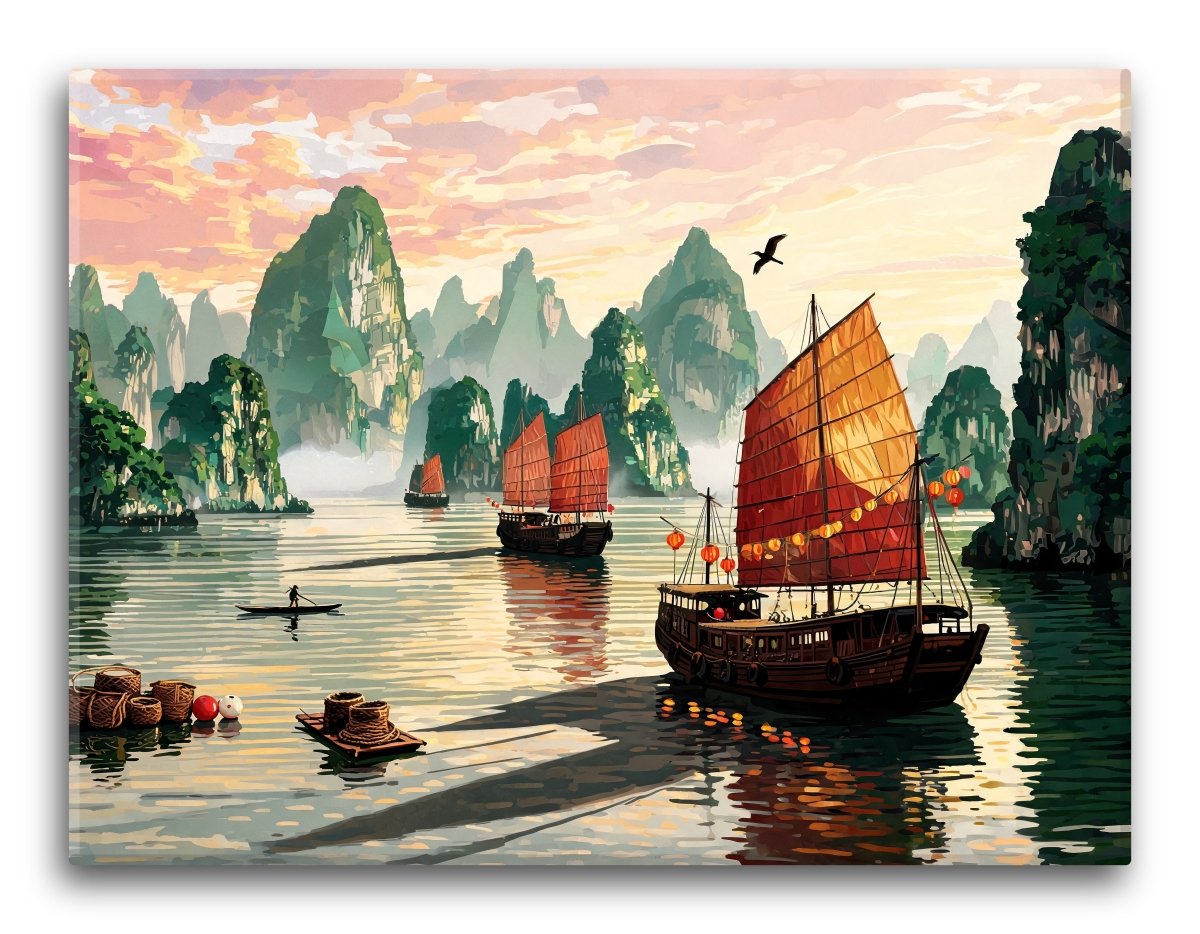
Your canvas came in a tube and it will not lie down. The corners lift, the middle bows, and every time you let go it springs back into a curl.
That is normal. It is also easy to fix with things you already have in the house. The one thing you cannot do is rush it, because flattening a canvas is mostly waiting.
Start it the evening before you want to paint and it will be ready when you are.
Why a rolled canvas arrives curled

A rolled canvas ships in a tube so it travels without a crease. Ours take six to ten business days to reach you, and the canvas spends all of that time wrapped around itself.
Cotton canvas has a memory. Hold any fabric in one shape for a week or two and the fibers settle into it. Cold weather makes it worse, because a cold canvas is stiffer and holds the curve harder.
The curl is just the shape the canvas has been sitting in, and the fix is to give it a different shape to settle into for a day.
Four methods that work

Any one of these will do it. If your canvas is tightly curled, use two of them in order: relax it first, then weight it.
Weight it flat overnight

This is the method almost everyone ends up using, because it needs nothing special.
Lay the canvas printed side up on a clean, flat surface. Put a clean sheet of plain paper over the print, then stack heavy books across the whole canvas. Cover the corners, not just the middle. Corners are where the curl lives.
Leave it overnight. A full day is better.
Roll it the other way

For a canvas that is curled hard enough to make the books useless, reverse the curve first.
Roll the canvas loosely the opposite way to how it arrived, with the printed side facing outward, around something wide like a rolling pin or a kitchen roll tube. Loosely is the important word. Hold it for ten or fifteen minutes, let it go, and repeat two or three times.
Then go straight to the books. On its own, reverse rolling only trades one curl for another.
Tape it to a board

If you want to start painting today, this is the fastest route.
Find a board, a tray or a sheet of stiff card that is bigger than the canvas. Lay the canvas on it and run low-tack masking tape along the blank margin at each edge, pressing the canvas gently square as you go. Do not stretch it, and keep the tape on the blank border rather than the printed area.
A taped canvas is flat enough to paint on straight away, and the tape stops the corners lifting into your hand while you work.
A little warmth, from a distance

Warmth relaxes the fibers so the weight can do its job faster.
The gentle version is to leave the weighted canvas somewhere warm and dry for a day, like an airing cupboard or a room with the heating on. The faster version is a hairdryer on its lowest setting, held a good arm's length back and kept moving, for under a minute over one area. The canvas should never feel hot to the hand.
The moment you stop, put the books back on while the canvas is still warm. It sets flat as it cools.
What not to do to a printed canvas

Most flattening advice online was written for blank artist canvas. A numbered canvas has printing on it, and printing does not survive everything.
- Do not wet it. Water swells cotton fibers and can blur or lift the printed numbers, and a blurred number is a shape you then have to guess at.
- Do not put an iron on the print, even through a cloth. Heat plus pressure is what moves ink.
- Do not fold it, not even for a second to fit it somewhere. A crease in canvas is permanent and it shows through the paint.
- Do not weight it under newspaper or a patterned cloth. Ink and dye transfer onto a damp or warm canvas.
- Do not leave it in a hot car, in a window, or on a radiator. Uneven heat bakes in a new curve.
How long to leave it

Overnight is the minimum. A full twenty four hours is the version that actually works, and two days is better for a canvas that arrived in a tight roll.
A cold room slows everything down. If the canvas has been sitting in a cold hallway, bring it inside for a few hours before you weight it.
Check it once a day rather than every hour. Lifting the books to look resets the clock a little each time.
When it is flat enough to start

Lay the canvas on the table and let go of it.
If the middle sits down on the table and the corners lift less than the width of a finger, you are ready. That last small lift disappears once you tape the canvas down or stretch it over bars at the end.
If the canvas still wants to roll itself back into a tube, give it another day under the books. Painting on one that is fighting you makes a slow job of an evening that should be easy.
If you would rather skip this step
Every design we sell comes framed or rolled, and the framed version arrives already stretched over a wooden frame. It lies flat on the table on day one, it is rigid while you paint, and it is ready to hang the evening you finish. If you know you will frame it anyway, choosing framed at the start saves you both the books and the stretching.
Rolled is still the right choice if you already own a frame that size, or if the canvas is going in the mail to someone else. You can see both options on any design in the full collection.
Questions about flattening a canvas

Can I paint on a canvas that is still a bit curled?
Yes, if you tape it to a board first. Painting on a loose curled canvas is the version to avoid, because your hand pushes the canvas around and the brush skips.
Will the curl come back once I start painting?
A little, in the corners, especially in a dry room. Keeping it taped to a board while you paint sorts it, and the paint itself adds a bit of weight and stiffness as you go.
Is a hairdryer safe on the print?
On a low setting, held well back and kept moving, yes. On high, held close, no. If the canvas feels more than mildly warm, you are too close.
What if my canvas arrived with a crease, not a curl?
A crease is a different problem and the methods above will not remove it. Take a photo of it and send it to us through the contact details on our policy page rather than trying to work it out yourself.
Which designs are easiest to start on once the canvas is flat?
Big open shapes are kinder for a first evening than fine detail. The beginner collection is picked on that basis, and our guide to starting your first canvas walks through what to paint first. If you are making a canvas from your own photograph, the custom kit arrives the same way and flattens the same way.


Deixe um comentário
Este site está protegido pela Política de privacidade da hCaptcha e da hCaptcha e aplicam-se os Termos de serviço das mesmas.