
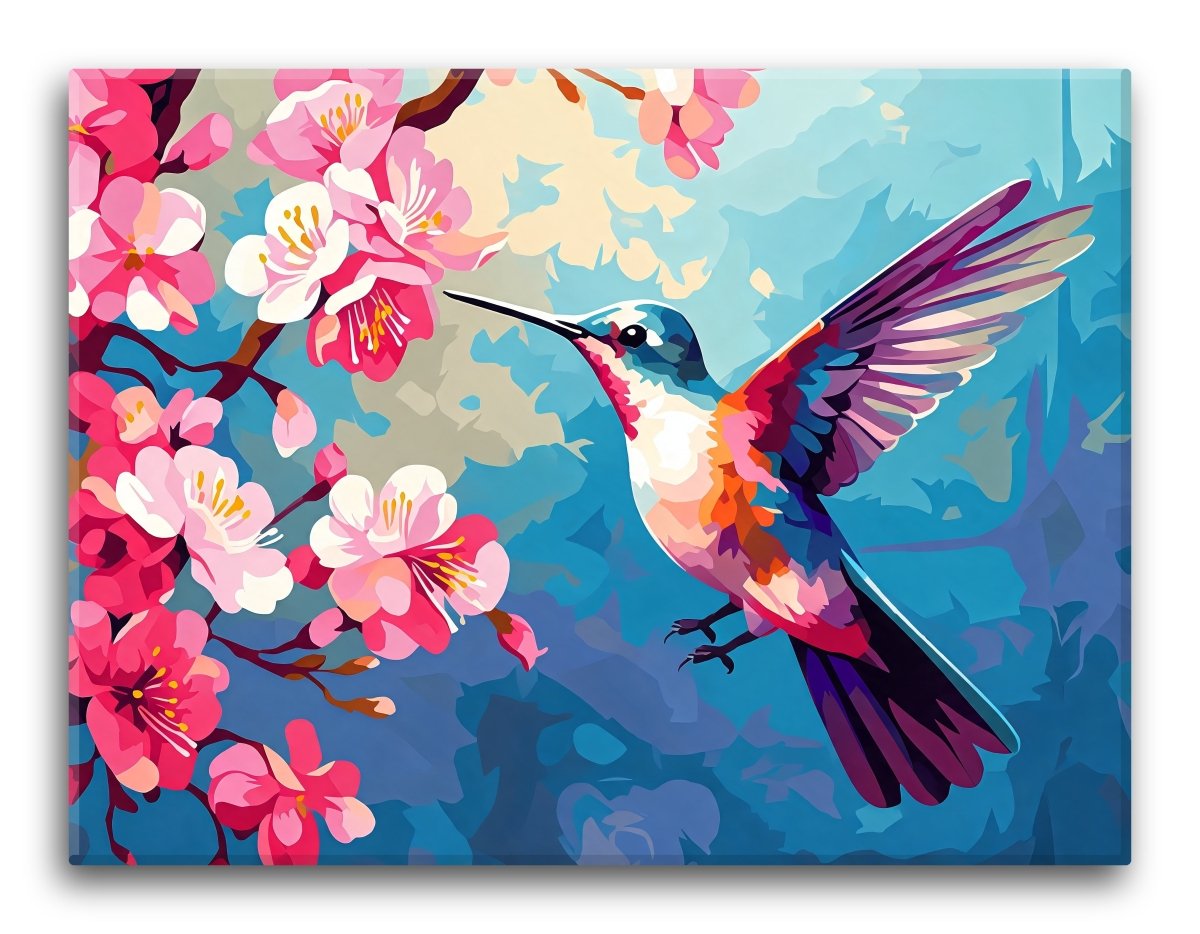
Almost nobody abandons a canvas because it was too hard. They abandon it because it was too slow.
Slow and hard are not the same thing in paint by numbers. There is no skill gate to fail. There is only a number of shapes, and if that number is enormous and the shapes are tiny, every evening buys you a smaller piece of picture than you hoped.
So choosing well is mostly about reading a design before you buy it, which takes about a minute.
The mistake that makes people abandon a canvas

The mistake is picking with your eyes and ordering straight away.
A crowded, detailed picture is the most tempting thing on a listing page. It looks the most impressive and it photographs the best. It is also the one with hundreds of shapes the size of a grain of rice, most of them in shades of the same color.
That canvas is perfectly paintable. It is just a long project, and a long project only works if you knew it was one. The people who stall thought they were buying a week of evenings and bought two months of them.
Reading a design before you buy it
Open the product photo as large as your screen will show it and look for three things.
How big are the shapes

Find the busiest corner of the picture and imagine a brush tip in it. If the shapes there look comfortable, the rest of the canvas will be easy. If they look like slivers, the whole painting will be worked at that pace.
Areas of sky, water, grass and plain background are your friends. They cover fast and they make the picture appear early, which is the bit that keeps you coming back.
How much flat color is there

Look for broad areas that are clearly one tone. A desert, a field, a wall, a block of sea. Those are the parts you can paint while half listening to something else, and every canvas needs some of them.
Then look at how many colors sit close together in tone. A picture built from six strong colors is a different evening from one built from four shades of gray, even if they have the same number of shapes.
Watch for faces, still water and night scenes

These three come up again and again in unfinished canvases.
Faces, human or animal, live or die on the eyes, and the eyes are always the smallest shapes on the canvas. Still water doubles everything, because the reflection is a second copy of the scene in slightly different shades. Night scenes replace clear color differences with a dozen dark tones that look identical in the pot.
All three are excellent paintings to own. Make them your second or third canvas, not your first, and order them on the Large size if you do take one on.
Subjects that stay interesting for twenty hours

You will be looking at the same picture across a lot of evenings, so pick one that holds up.
What tends to hold up is a picture with some variety in it. A landscape that moves from sky to mountain to water gives you three different kinds of painting in one canvas. A single flower on a plain ground is lovely but it is the same move repeated, and it can get dull before it is done.
What also holds up is a picture that means something. A place you have been, an animal you had, a view from a window you remember. Nothing in a catalog competes with that for pulling you back to the table on a Tuesday night.
Match the design to the time you actually have

If you paint for an hour or two a few nights a week, a simple open design is a satisfying short project and a dense detailed one is a season of your life. Both are fine. Choosing without knowing which you picked is what goes wrong.
As a rough guide, big shapes and under thirty colors make a quick canvas. Dense detail, fine texture or lots of close shades make a slow one. Our beginner collection and expert collection are sorted on that basis rather than on subject, so you can start from the pace you want and find a picture inside it.
Choose for the room it will hang in

The canvas ends up on a wall, so let the wall have a vote.
Think about the colors already in the room. A painting full of warm reds and ochres sits well in a room with wood and warm light, and fights a cool gray and blue one. You do not need to match anything exactly. You just want the painting to look like it belongs there.
The shape of the space matters too. Some of our designs are taller than they are wide and some are wider than tall, and the wrong shape in a space is more obvious than the wrong subject. A tall canvas suits a narrow wall or the gap beside a window. A wide one suits the space above furniture.
Size is worth a thought as well. The same design comes as Classic 12 by 16 inches and Large 16 by 20 inches, and the larger one is the easier of the two to paint because every shape is roomier.
Choosing one as a gift for someone else

Choosing for another person is harder, because you cannot check how they feel about small shapes.
Play it safe on difficulty. A simple, open design that finishes in a couple of weeks is a far better present than an ambitious one that sits in a cupboard. If they have never painted before, this matters more than the subject.
Play it personal on subject. Their dog, their favorite coast, the flowers in their garden, the city they talk about. A design they have a reason to want on the wall will be finished.
And choose framed rather than rolled. It arrives flat and ready, they can start the same evening, and there is nothing to sort out at the end.
When nothing in the catalog is quite right

Sometimes the picture you want is already on your phone.
A custom kit turns a photograph into a numbered canvas with its own matched pots, so the design is one you are certain about before you start. It is the surest way to pick a subject that will hold your interest.
Our guide to turning a photo into a paint by numbers canvas covers which photographs work and which ones do not.
A checklist before you add it to the cart

One minute, seven questions.
- Zoom into the busiest corner. Are those shapes a comfortable size?
- Are there big flat areas to balance the detail?
- How many colors sit close together in tone?
- Does the subject have any variety in it, or is it one move repeated?
- Is there a reason you want this particular picture on a wall?
- Does the shape suit the space you have in mind?
- Classic or Large, and framed or rolled?
If they point at a long project and you want one, order it with confidence. If they point at a long project and you wanted a quiet couple of weeks, keep looking. The full catalog has over 850 designs and the best sellers are a good place to narrow it down.
Questions people ask when choosing a paint by numbers design
How do I know if a design is too hard for me?
Difficulty in paint by numbers comes down to shape size and how close the colors are. Zoom into the most detailed part of the picture. Tiny shapes and many similar tones mean a slow canvas, and it will still be paintable.
What is a good first design?
Big open shapes, a clear difference between light and dark, and a subject you like. A simple flower, one animal against a plain background, or a landscape with plenty of sky. Our beginner collection is picked on that basis.
Does the number of colors tell me how hard it is?
It helps, up to a point. More colors usually means more small shapes. But twenty close shades of gray will take longer than thirty colors that are easy to tell apart.
Should I pick a design I love or one that is easy?
Both, if you can. Wanting to see it finished is what gets you through the dull middle stretch, so never pick something you are lukewarm about just because it looks quick.
Can I change the size after I order?
Size and finish are chosen on the product page before you check out, so decide there. If you are unsure, the Large canvas is the kinder one to paint on, whatever the design.


Deixe um comentário
Este site está protegido pela Política de privacidade da hCaptcha e da hCaptcha e aplicam-se os Termos de serviço das mesmas.