
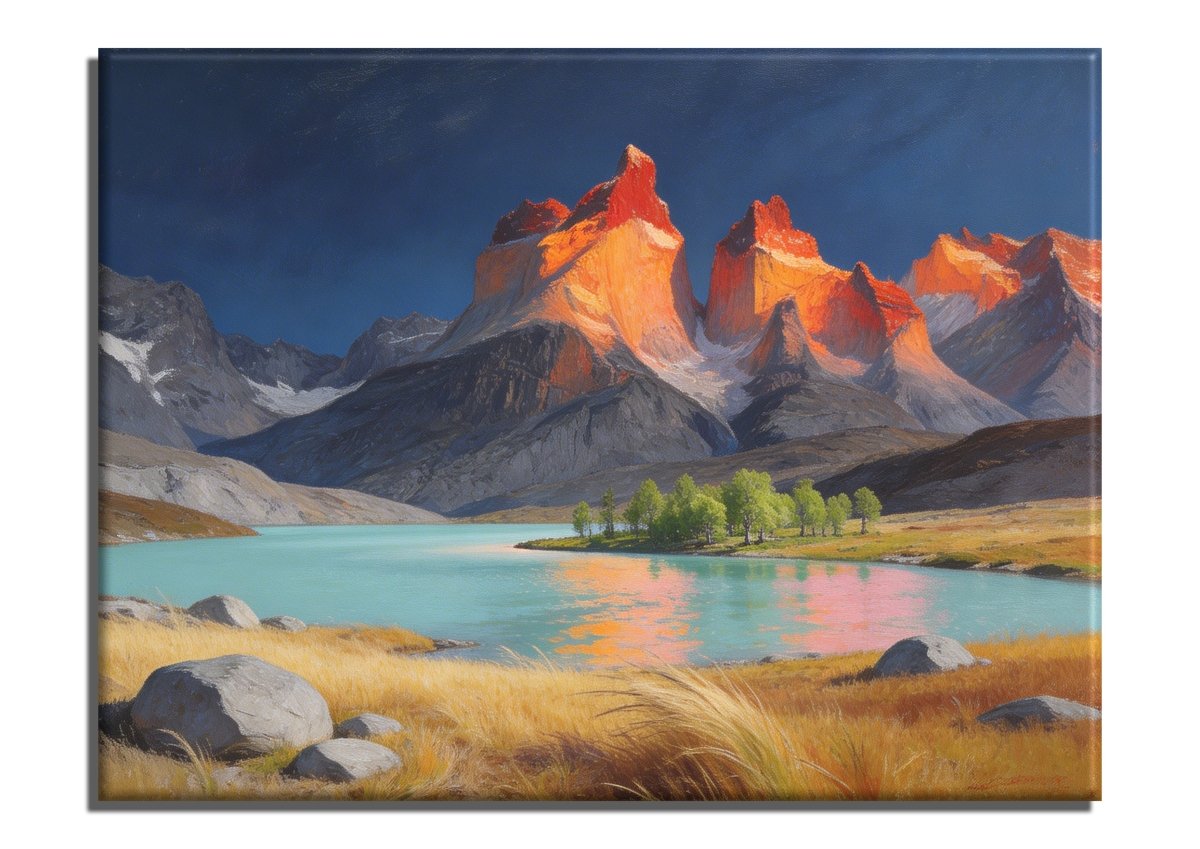
Most paint by numbers kits look the same in a photo. A pretty picture, a row of little paint pots, a brush or two. The listing almost never tells you how the kit will feel to paint.
You find that out on the first night. A good kit is calm. The lines are easy to read, the paint covers, and one more corner always sounds nice. A rough kit fights you. The paint goes on streaky, the shapes are too small for the brush, and the whole thing ends up in a closet.
Here is what makes the difference. Almost none of it is the picture on the front.
What is in every kit

Adult kits all come with about the same four things.
- A canvas printed with numbered shapes
- Small pots of acrylic paint, one for each number
- Brushes
- A reference picture of the finished design, printed or online
The parts are the same everywhere. The quality is not. The rest of this guide is what to check before you pay.
Is the canvas printed in color or left white?

This is the easiest thing to miss in a listing. It changes how the whole kit feels.
On a plain white canvas, every shape is white with a small number inside it. Two problems come with that. The numbers are hard to read under a lamp, because thin grey print on white has almost no contrast. And if your paint is at all thin, the white shows through and the color looks washed out. Skip a shape by mistake and it glows at you from across the room.
On a pre-colored canvas, each shape is already printed in a light version of the color it will become. The sky area is faint blue. The leaves are faint green. You can still read the numbers, and now they sit on a soft background instead of glaring white. If your brush misses a sliver, the sliver is close to the right color anyway, so nobody sees it.
Our canvases are lightly tinted this way. Plenty of other shops do it too. It is worth hunting for in the photos, because a seller who prints in color is usually paying attention to the rest of the kit as well. Zoom into the product photos and look at an unpainted corner. If it is bright white, you know what you are getting.
Do the paints cover in one coat?

Paint quality is where a cheap kit cuts first, and it costs you the most time.
Cheap acrylic is watery. You paint a shape, it dries, and you can still see the number through it. So you paint it again. And again. A section that should take ten minutes takes half an hour, and the surface ends up thick and bumpy where you kept going over it.
Good paint covers the first time. One pass, done, move on. That one difference is most of what people mean when they say a kit was relaxing.
You cannot test paint through a screen, so read what people say about it. Reviews that mention watery paint, three coats, or having to buy their own acrylics are telling you plenty. Our paints are made to cover in one coat.
How many brushes, and what sizes?

Brush count varies more than you would think. Some kits hand you one brush for the entire canvas, which is a problem at both ends. A wide brush cannot fit a thin shape. A tiny brush takes forever on a big sky.
What you want is a few sizes. A fine tip for small shapes, something medium for most of the work, and a wider one for open areas. Every kit we sell has six brushes, which covers the range without making you think about it.
If a kit you like only comes with one or two, a cheap set of craft brushes fixes it for a few dollars. Just know you will be buying them.
Does every pot have a number on it?

It sounds too basic to check. Check it anyway.
Some kits print the numbers on a sticker sheet, or only label a few pots, or put the numbers on the tray instead of the pots. The moment you lift a pot out to paint, you lose track of which one it is. Then you are holding two near-identical greys and guessing.
Every pot in our kits has its own number printed on it. When you are comparing other kits, look for a photo of the pots from above. If you can read a number on each lid, good. If the photo only shows the tray, ask.
Is it real canvas?

Some kits use a thin printed sheet that is closer to paper than canvas. It creases, it soaks up paint unevenly, and it never looks right on a wall even when the painting itself came out well.
Real canvas has a visible weave and enough weight to hold paint without buckling. Ours is real canvas. Product photos usually give this away. Look for a close shot where you can see the texture.
Size, and why it decides how hard the painting is

Size is about more than your wall. It sets how small the shapes are.
The same design printed smaller has the same number of shapes squeezed into less room. Everything gets tighter. Eyes, petals, and small highlights turn into slivers you need a steady hand for.
We print two sizes. Classic is 12 by 16 inches, and Large is 16 by 20 inches. For a first kit, or for any design with a lot of fine detail, the bigger canvas is the kinder choice. The shapes are roomier and the painting goes faster, which sounds backwards until you try it.
Whatever shop you buy from, check the listed size against the detail in the picture. A simple landscape works fine small. A face does not.
Framed or unframed

Unframed usually means the canvas arrives rolled in a tube. It is cheaper to ship, and most people are fine with it. You do have to flatten it before you paint, and you need a plan for hanging it later. Stretching one yourself means buying wooden bars and spending an evening on it, or paying a frame shop to do it.
Framed means it arrives on a wooden stretcher, flat and ready. You paint it as it is and hang it when you are done. It costs more and the box is bigger.
We sell both ways on every design. Pick unframed if you like the saving or already own a frame. Pick framed if you want the thing on the wall the week you finish it.
How long until it shows up?

Shipping time matters most when the kit is a gift. Stated times vary a lot between shops, from a few days to several weeks, and a slow one is fine for yourself and no good for a birthday.
Ours ship in six to ten business days. Before you order anywhere, find the stated time instead of assuming. If a shop does not say, treat that as its own answer.
How to pick a design you will actually finish
The picture matters less than the kind of picture. Some subjects are forgiving and some punish a shaky hand.
For a first kit

Look for big open shapes and a clear difference between light and dark. Simple flowers, a single animal against a plain background, a landscape with a lot of sky. Our beginner collection is sorted this way, and other shops often have an easy or starter tag that does the same job.
Count the colors if the listing says. Fewer colors means fewer tiny shapes and fewer pots to keep straight.
For your second or third

Now you can take on texture. Fur, feathers, water with some movement in it, flowers with layered petals. The shapes get smaller, but you know how your brush behaves, so that is fine.
When you want it to be hard

Faces, still water with reflections, night scenes, and busy city streets are the hard end. They have the most shapes, the smallest shapes, and the closest colors. They are also the most satisfying to finish. Just do not make one your first.
If you want to browse by what catches your eye instead of by difficulty, our full catalog has over 850 designs. Or skip the catalog and send us a photo you already love, and we will turn it into a custom kit with its own numbered canvas and matched paints.
Where people end up disappointed
These are the complaints that come up again and again about kits in general. Each one maps back to something you can check first.
- Paint so thin it needs three coats, so the painting takes three times as long
- A white canvas with pale printed numbers that are hard to read in evening light
- Shapes too small for the brush that came in the box
- Unlabeled pots, or stickers that fall off in the mail
- A thin paper-like canvas that creases and will not sit flat
- Two numbers that look like the same color in the pot, so a mistake is invisible until it dries
- A rolled canvas that keeps curling at the corners while you paint
Most of these come from one decision somewhere: the kit was built to hit a price. That is also why the cheapest kit on a marketplace is rarely the best value.
What you should expect to pay

Prices sit in a wide range. The cheapest marketplace kits cost a few dollars, and a large framed canvas costs several times that. Ours start at $19.95.
Near the bottom of that range, something has usually been cut, and it is normally the paint. Near the top, you are mostly paying for a bigger canvas or a frame rather than a better painting. Most of the good kits sit in the middle.
A short checklist
Before you buy, from us or from anyone:
- Zoom in on an unpainted corner. Printed in color, or white?
- Search the reviews for the word "coats"
- Count the brushes in the photo
- Find a photo where you can read a number on each pot
- Check the canvas size against how much fine detail the picture has
- Decide on framed or rolled before you add to cart, not after
- Find the stated shipping time
- Read the return policy, especially if it is a gift
None of that takes long, and it sorts the kits you will finish from the ones you will shove in a closet. If you only have time for one check, zoom in on the canvas.


Deixe um comentário
Este site está protegido pela Política de privacidade da hCaptcha e da hCaptcha e aplicam-se os Termos de serviço das mesmas.